
28 Traditional Jingdezhen Glazes Explained — Did Ru Ware Really Use Agate?
I’d like to give you a clear introduction to traditional color glazes in Jingdezhen.This time, we selected 28 representative glaze colors as samples, and I will explain them by dividing them into three main categories.
Category One: Ru-style Glazes
The first and most important group is what we call the “Ru-style” glaze system.
Ru ware originally appeared in the late Northern Song Dynasty, in Henan province. It is famous for its soft bluish-green celadon glaze.
Interestingly, the earliest porcelain excavated in Jingdezhen was mainly egg-white glaze and Yingqing ware. Some ceramic historians believe that after the fall of the Northern Song Dynasty, many craftsmen moved south, bringing their glaze techniques with them. Over time, this may have influenced Jingdezhen.
Today in Jingdezhen, many soft, jade-like glazes are named with the prefix “Ru,” such as:
Ru blue
Ru white
Ru pink
Ru yellow
Ru orange
In our common glaze system, there are about 13 colors that begin with “Ru.”
Ru-style glazes are typically:
– High-fired above 1300°C
– Soft and warm in tone
– More matte than glossy
– Often centered around sky-blue hues
They also extend into tones like powder blue, moon white, light grey, and so on.
Overall, they give a feeling of warmth and quiet elegance.
Category Two: High-Fire Bright Glazes
The second category is also high-fired, but not part of the Ru-style family.
These glazes are brighter, more saturated, and more decorative. They are not matte and soft like Ru glazes — they are vivid and eye-catching.
Among our samples, common high-temperature bright glazes include:
Indigo blue
Imperial yellow
Lang kiln blue
Lang kiln red
Peacock green
High-temperature purple
These glazes are glossy, bold, and visually strong.
Category Three: Mid-Temperature Glazes
The third category is mid-temperature glazes, fired at around 1200°C.
If you fire them at 1300°C, the color will change or even completely transform.
Our samples include:
Light green
Blue
Grass green
Blue-green
Yellowish tone
Eel yellow
Light blue
Purple
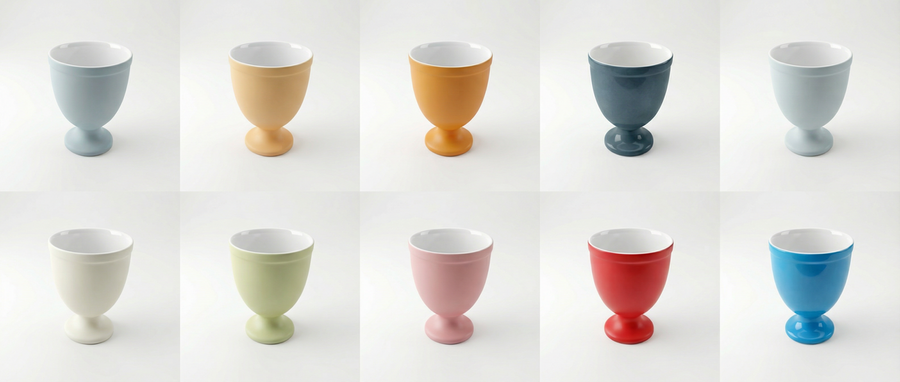
These are also widely used traditional decorative glazes.
I know this video might be a bit longer, but I hope it helps you understand that glaze colors come from material systems and firing technology — not legends.
The Question: Was Ru Ware Made with Agate?
Whenever we talk about Ru glaze, people always ask:
“Is it true that Ru ware used agate in the glaze?”
Some craftsmen claim that agate was added into the glaze, making it more pure and more jade-like.
This idea appears in Ming and Qing dynasty writings and in traditional craft stories.
But what does modern science say?
What Is Agate?
Agate is basically silicon dioxide — SiO₂.
In simple terms, it is a type of quartz.
But quartz is already the main ingredient in ceramic glaze.
So chemically speaking:
Agate is just high-purity silica.
If you grind agate into powder and add it into glaze, you are essentially adding high-purity silica. There is nothing mysterious about it.
What Do Modern Tests Show?
Scientific analysis of Northern Song Ru kiln shards shows that the glaze mainly contains:
Silica/Alumina/Calcium/Alkali metals
There is no evidence of any special agate structure.
In other words:There is no proof that agate was a necessary or key ingredient.
Why Did the “Agate” Story Appear?
There are a few possible explanations.
First, ancient craftsmen may have used agate as a high-quality silica source. Agate looks pure and precious, so it was considered a good material.
Second, it may have been a literary exaggeration. Song Dynasty aesthetics valued qualities like:
“Blue as the sky”
“Smooth like jade”
Saying “agate was added” may have enhanced the sense of rarity and beauty.
Third, even if agate was used in small amounts, it was not the key factor in creating the glaze color.
What truly determines the Ru glaze color is:
Low iron content
Reduction firing atmosphere
High-calcium glaze system
Temperature control
Kiln position
Glaze thickness
Microcrystalline glass structure
The soft blue tone comes from trace iron under reduction firing conditions — not from agate itself. Agate does not create blue color.
Final Thoughts
So yes, historical records mention agate.
Yes, technically it could have been used.
But no scientific evidence shows it was essential.
And the glaze color mechanism is not directly related to agate.
Most likely, agate was simply one possible silica source — not a mysterious secret formula.
The sources for my video content comes from Wikipedia and research results gathered through ChatGPT. If you have different opinions, feel free to write your comment to potteryshowcase@outlook.com.