
From Austria to Jingdezhen: Martina’s Global Journey Through Ceramics
From Austria to Jingdezhen: Martina’s Global Journey Through Ceramics
Returning to Jingdezhen After 11 Years: An International Artist’s Unfinished Project
Meeting Austrian Ceramic Artist Martina in Jingdezhen
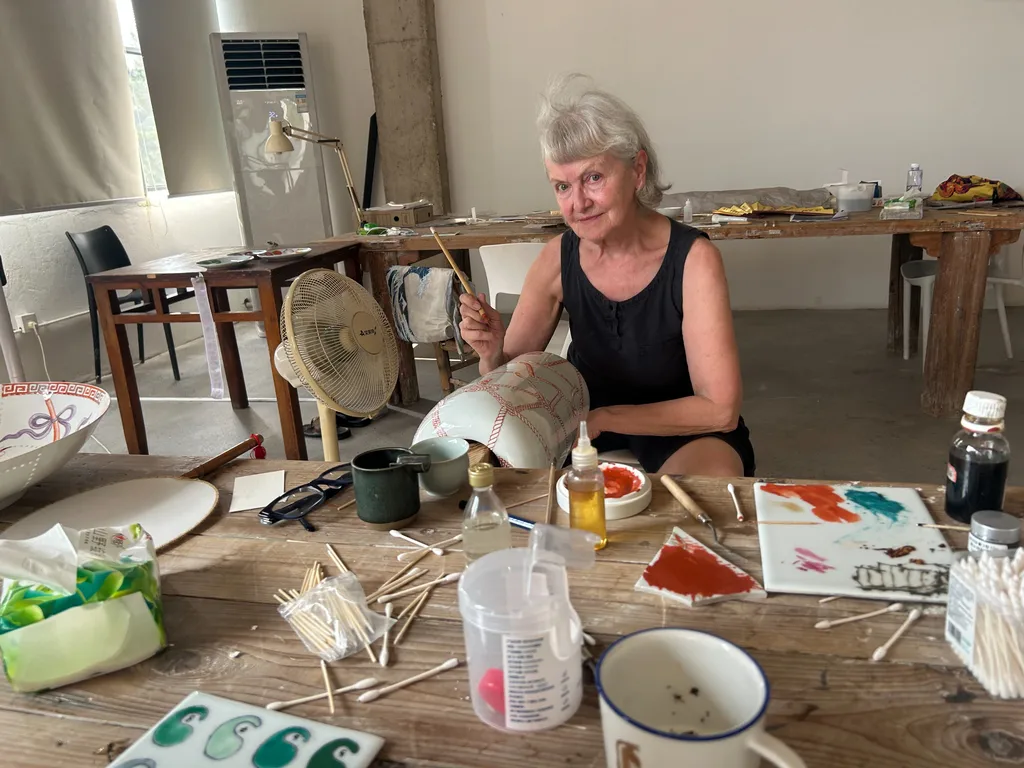
During my recent visit to a ceramic studio hidden among the hills outside Jingdezhen, I had the opportunity to meet Austrian ceramic artist Martina.
Unlike the larger and better-known residency programs in Jingdezhen, this small studio is not widely promoted. Tucked away among trees and quiet village roads, it serves primarily as a production workshop and creative space shared by a small circle of artists and friends.
For Martina, however, this peaceful environment provides exactly what she needs: time, space, and freedom to continue a project she began more than eleven years ago.
A Lifelong Connection with Asia
Martina’s relationship with Asia began long before she discovered Jingdezhen.
More than thirty-five years ago, she received a Japanese-Austrian government scholarship and spent two semesters studying in Kyoto.
Her interest in East Asian ceramics started even earlier while studying ceramics at university in Austria. Influenced by teachers who admired both Japanese tea ceramics and Chinese Song Dynasty ceramics, she developed a deep appreciation for porcelain traditions.
Since then, she has traveled extensively throughout Asia, visiting ceramic centers in Japan, China, Korea, Indonesia, India, and many other countries.
“Even as a child growing up in a small Austrian town with only about 2,000 residents, I was fascinated by foreign cultures,” she explained. “I always wanted to travel and discover the world.”
Discovering Jingdezhen
Martina first learned about artist residencies in Jingdezhen in 2007 while attending an international ceramic biennale in Korea.
After receiving an art award that year, she used the prize money to fund a six-month stay in Jingdezhen.
Like many international artists, she quickly discovered that Jingdezhen offered something unique.
The city was not necessarily famous for spectacular architecture or tourism at that time. Instead, it offered an extraordinary ceramic ecosystem.
Artists could find specialized craftsmen, mold makers, painters, throwers, glaze technicians, kiln operators, and manufacturers all within the same city.
For ceramic artists, it was an ideal environment for experimentation and production.
From Professor to Full-Time Artist
Throughout her career, Martina worked in many roles.
She taught mold-making in Austria, lived in San Francisco for several years, organized workshops around the world, and later became Head of the Ceramic Department at a university in Vienna.
She also taught visiting courses at universities in Wuhan and collaborated with ceramic programs across Europe, North America, and Asia.
Between 2017 and 2020, she organized study tours that brought students and professors from Vienna to China.
These programs combined ceramic art with architecture, introducing participants to Jingdezhen, Hangzhou, Ningbo, and other culturally significant locations.
Today, Martina is officially retired.
However, retirement has simply given her more freedom to travel, learn, and create.
Finishing an Artwork Eleven Years Later
One of the most fascinating aspects of Martina’s current stay in Jingdezhen is the reason she returned.
More than a decade ago, she commissioned a series of porcelain forms from local manufacturers and began decorating them with painted imagery.
Many of those pieces remained unfinished.
When she returned to Jingdezhen recently, she decided it was finally time to continue the project.
“I thought it would take only a few weeks,” she laughed. “But it is taking much longer than I expected.”
Instead of hiring professional painters, Martina chose to paint many of the pieces herself, treating the process as an opportunity to learn new skills and revisit old ideas.
For her, unfinished work is not a failure.
She pointed out that even Leonardo da Vinci left many works incomplete.
The important thing, she believes, is continuing the creative journey.
Curiosity as a Creative Force
Unlike many artists who spend years developing a single recognizable style, Martina follows a different path.
Throughout her career she has worked with wheel throwing, mold making, porcelain casting, hand-building, digital fabrication, 3D printing, painting, and installation art.
She describes herself as endlessly curious.
“I always want to learn everything,” she said.
This curiosity sometimes makes it difficult to choose a single direction, but it also keeps her creative practice alive and evolving.
One year she may focus on 3D printing. Another year she may become interested in traditional Chinese painting techniques.
For Martina, learning itself is part of the artwork.
The Meaning Behind the Ropes
Several of Martina’s recent works feature intricate rope and knot motifs painted across porcelain surfaces.
When asked about their meaning, she explained that the original inspiration came from an older porcelain object she had seen in Vienna.
The simple rope decoration captured her attention, but over time her own interpretations became increasingly complex.
More recently, she discovered the mathematical field known as Knot Theory and began exploring connections between mathematics, structure, and visual form.
Although viewers may interpret the ropes differently—perhaps as symbols of restraint, connection, control, or entanglement—Martina prefers to leave space for multiple readings.
The artwork invites viewers to bring their own experiences and perspectives.
Why She Continues Creating
Perhaps the most revealing part of our conversation was when I asked why she continues making art.
Was it for exhibitions?
Recognition?
Sales?
Profit?
Her answer was simple.
“I do it because I enjoy it.”
Although she occasionally sells work, commercial success is not her primary motivation.
Her pension provides enough financial stability to support her travels and artistic activities.
For Martina, making art is not a business strategy.
It is a way of remaining curious, learning continuously, and staying connected to the world.
Finding Freedom Through Creativity
Martina has chosen a life different from many of her peers.
She never married and does not have children.
As a result, she has enjoyed the freedom to travel extensively and devote herself fully to artistic exploration.
When discussing social changes in Europe and Asia, she reflected on how younger generations increasingly question traditional expectations surrounding work, family, and success.
For her, there is no single correct path.
Had life unfolded differently, she may have had a family.
Instead, she found fulfillment through creativity, travel, and friendships around the world.
Jingdezhen as an International Creative Home
After nearly two decades of returning to China, Martina continues to view Jingdezhen as one of the most inspiring places for ceramic artists.
Its combination of traditional craftsmanship, technical expertise, artistic experimentation, and international exchange remains difficult to find elsewhere.
For artists willing to explore, learn, and collaborate, Jingdezhen offers opportunities that extend far beyond ceramics.
It offers a community.
And for artists like Martina, it has become a second home.
About the Interview
This interview was conducted in Jingdezhen, China, in May 2026.
Martina is an Austrian ceramic artist, educator, former university department head, and longtime participant in international ceramic residency programs throughout Asia, Europe, and North America. Her work spans porcelain, painting, casting, mold-making, installation, and contemporary ceramic practice. 内容根据采访整理。
Written and edited by Li Sheng
Documentary storyteller, ceramic community organizer, and independent researcher based in Jingdezhen, China.