
How Giant Ceramic Masterpieces Are Made in Jingdezhen
Discover the Extraordinary World of Monumental Ceramics
When most people think of Jingdezhen, they imagine delicate porcelain teacups, elegant blue-and-white ceramics, and centuries of traditional craftsmanship. However, hidden inside some of the city’s workshops is another remarkable tradition—the creation of giant ceramic masterpieces.
These monumental works include towering vases that stand more than two meters tall, enormous decorative jars, large-scale sculptural installations, and custom ceramic pieces designed for luxury hotels, museums, public spaces, gardens, and international art exhibitions.
Producing ceramics on this scale is one of the most technically demanding forms of ceramic art. It requires not only artistic talent but also engineering knowledge, teamwork, specialized equipment, and years of experience.
A Tradition Dating Back Hundreds of Years
Large-scale ceramic production is not a modern invention.
Historical records show that during the Ming Dynasty, the Imperial Kilns of Jingdezhen produced magnificent blue-and-white dragon jars for the imperial court. These monumental vessels represented the highest level of ceramic craftsmanship in China and demonstrated the remarkable technical abilities of Jingdezhen’s master potters.
Today, although modern technology has improved production, the fundamental challenges of creating giant ceramics remain much the same.
Why Is It So Difficult to Make Giant Ceramics?
1. The Clay Must Support Its Own Weight
The larger a ceramic vessel becomes, the more difficult it is to control.
Wet clay is extremely heavy, and as the height increases, the walls of the vessel must support enormous pressure without collapsing. Selecting the right clay body and controlling moisture throughout the process are essential for success.
2. Large Vessels Are Built in Sections
Contrary to what many visitors imagine, giant ceramic vases are rarely thrown in one piece.
Instead, experienced potters create separate sections—including the base, lower body, shoulder, neck, and rim—which are carefully joined together after partial drying. Every connection must be precisely aligned to maintain both strength and symmetry.
3. Drying and Firing Require Extraordinary Patience
Drying a large ceramic work too quickly may create invisible cracks that only appear during firing.
Inside the kiln, temperatures reach approximately 1,300°C (2,370°F). During this stage, shrinkage, thermal stress, and glaze reactions can lead to cracking, warping, or even complete failure.
Even for experienced ceramic masters, every firing involves a degree of uncertainty.
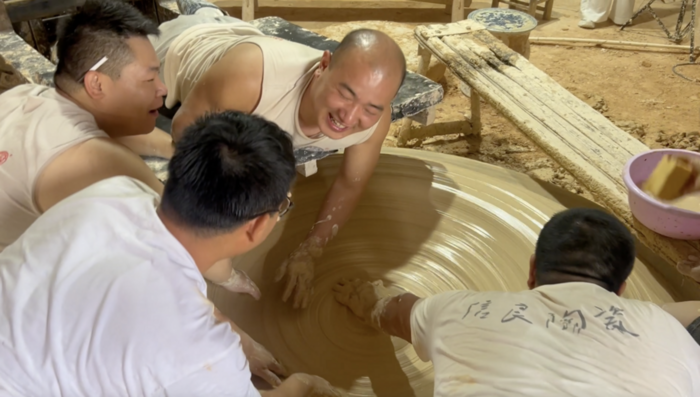
4. Large Ceramics Are a Team Effort
Unlike smaller studio pottery, monumental ceramics cannot usually be completed by one artist alone.
Creating a large ceramic piece often requires a collaborative team that includes clay specialists, master throwers, assemblers, decorators, kiln technicians, and logistics personnel. Every stage depends on careful coordination and shared expertise.
5. Decorating a Giant Vessel Is Like Painting a Mural
Once the ceramic form has been completed, artists begin the decoration process.
Because the surface is curved rather than flat, maintaining accurate proportions and flowing brushwork becomes much more challenging. Artists frequently work from ladders or lifting platforms while painting large ceramic surfaces by hand.
Traditional Craftsmanship Meets Modern Technology
Although large ceramics are still handmade, today’s workshops combine traditional skills with modern equipment.
Heavy-duty electric pottery wheels make it possible to throw massive amounts of clay. Electric forklifts, lifting platforms, and specialized transportation equipment allow large ceramic bodies to be moved safely throughout the workshop.
Rather than replacing craftsmanship, modern technology supports artisans in creating works that would otherwise be impossible.
Why International Artists Come to Jingdezhen
Every year, ceramic artists, sculptors, designers, and university researchers travel to Jingdezhen from around the world.
Many bring their own artistic concepts but collaborate with experienced local craftsmen to produce the large ceramic forms. Once the structure is completed, visiting artists add their own painting, sculpture, or installation concepts before the works are glazed and fired.
This unique combination of artistic creativity and technical expertise makes Jingdezhen one of the world’s most important destinations for large-scale ceramic production.
Custom Large Ceramic Production and Artist Residency Support
If you are planning to create a monumental ceramic sculpture, prepare work for an international exhibition, or commission a custom large ceramic installation, Jingdezhen offers an exceptional production environment.
We can help coordinate:
- Artist residency programs
- Large-scale ceramic workshops
- Master craftsmen and technical support
- Kiln firing services
- Accommodation and studio space
- Logistics, storage, and international shipping
Whether you are a professional ceramic artist, sculptor, architect, designer, or collector, our goal is to help bring your creative vision to life in Jingdezhen.
Experience the World’s Porcelain Capital
Watching hundreds of kilograms of clay transformed into a monumental ceramic artwork is an unforgettable experience.
Behind every finished piece are countless hours of craftsmanship, teamwork, patience, and technical skill.
Jingdezhen is more than the Porcelain Capital of China—it is a place where history, innovation, and artistic creativity continue to shape the future of ceramics.