
The Inspiring Journey of Turkish Ceramic Artist Pinar Baklan
Sometimes, the most meaningful career decisions are not the safest ones.
For many artists, securing a university teaching position is considered the ultimate professional achievement—a stable salary, academic recognition, and a clear path toward becoming a professor.
Turkish ceramic artist Pinar Baklan chose a different path.
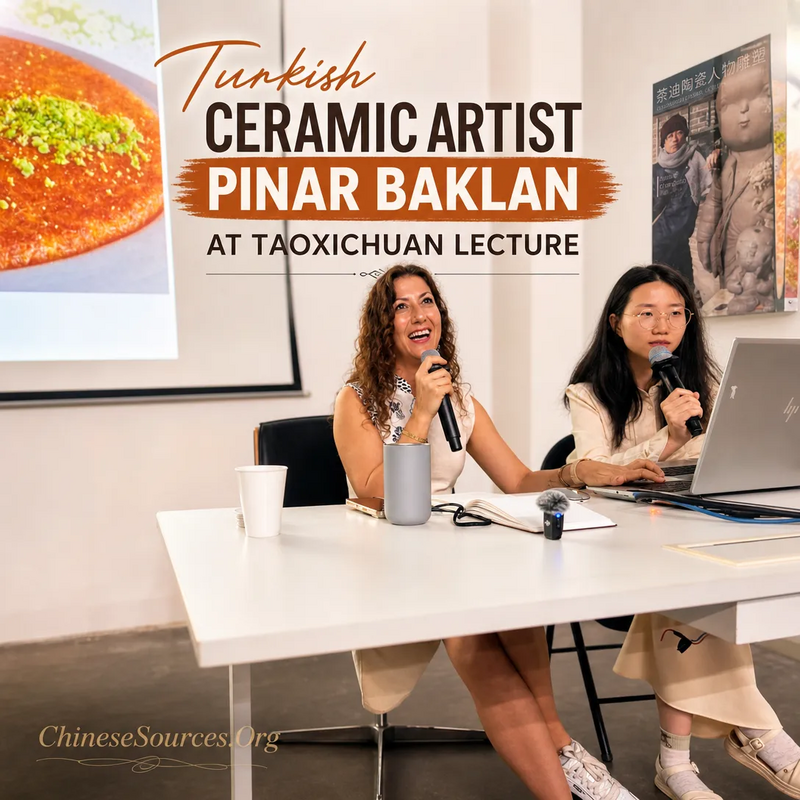
After spending more than a decade teaching ceramics at university, she left academic life to become a full-time independent artist. Today, her work is exhibited internationally, and her story has inspired artists around the world.
I had the opportunity to attend her lecture during the International Academy of Ceramics (IAC) Congress in Jingdezhen, China. While her ceramic sculptures were impressive, it was the story behind her work that left the deepest impression.
An Academic Career Many Artists Dream Of
Pinar Baklan earned her Bachelor’s, Master’s, and Ph.D. degrees in Ceramics from Hacettepe University in Türkiye.
She worked as a research assistant before becoming a university lecturer, following the traditional academic route that many artists spend years pursuing.
During this period, she participated in artist residencies, international symposiums, research projects, and exhibitions throughout Europe and beyond. Her ceramic sculptures received awards and became part of museum and private collections.
By conventional standards, her career was already a success.
Yet she felt that something was missing.
Choosing Freedom Over Security
One of the most memorable moments of her lecture was when she explained why she resigned from the university after twelve years of teaching.
For many people in Türkiye, a permanent university position represents long-term security and prestige. Walking away from such a career was difficult for both her family and friends to understand.
However, Pinar believed she should not postpone the life she truly wanted until retirement.
Instead, she decided to build that life immediately—even though it meant giving up financial certainty.
Her decision reflects a challenge many creative professionals face: balancing stability with artistic independence.
Building a Studio—and a New Life
After leaving academia, Pinar moved to Marmaris, a coastal town in southwestern Türkiye surrounded by forests, mountains, and the Mediterranean Sea.
There she gradually built the creative environment she had always imagined.
Her studio became more than a workplace. It became part of her daily life, surrounded by nature, gardens, and the quiet rhythm of rural living.
Like many independent artists, she faced uncertainty in the beginning. Selling ceramic works became both her artistic practice and her livelihood.
Rather than separating work from life, she integrated the two into a single creative lifestyle.
How Wildfires Changed Her Art
A turning point in Pinar’s artistic journey came when devastating wildfires swept through southern Türkiye.
The forests surrounding her home were severely damaged, permanently changing the landscape she lived in every day.
Instead of avoiding this painful experience, she incorporated it into her ceramic sculptures.
Burned wood, charred textures, and references to damaged trees began appearing in her work—not simply as materials, but as symbols of memory, resilience, and renewal.
Her ceramics evolved from formal experiments into deeply personal reflections on environmental change and human experience.
From Optical Art to Emotional Storytelling
Earlier in her career, Pinar’s research focused on Optical Art, exploring how patterns, lines, colors, and ceramic surfaces could create visual illusions.
Over time, those visual elements remained, but their meaning changed.
Rather than emphasizing optical effects alone, her work increasingly explored communication, relationships, memory, and emotional connection.
During her lecture, one sentence stood out:
“I believe good dialogue can solve many problems.”
That philosophy extends beyond conversation—it also defines her artistic practice.
For Pinar, ceramics are a language capable of expressing ideas that words cannot.
Ceramics as a Bridge Between Cultures
Pinar also spoke about the long historical relationship between Turkish ceramics and Chinese porcelain.
For centuries, Chinese ceramic traditions influenced ceramic production throughout the world, including the famous Iznik ceramics of Türkiye.
Today, that cultural dialogue continues in a different way.
Instead of merchants transporting porcelain across continents, artists travel, exchange ideas, and learn from one another.
Watching a Turkish ceramic artist share her experiences in Jingdezhen—the Porcelain Capital of China—was a powerful reminder that ceramics continue to connect cultures across borders.
More Than Objects of Beauty
One of the strongest messages from Pinar’s lecture was that contemporary ceramics are not simply decorative objects.
Each sculpture represents a chapter of her life.
Her academic career.
Years of teaching.
International travel.
Artist residencies.
The difficult decision to resign.
The impact of wildfires.
Personal growth and transformation.
Her work functions almost like a visual autobiography, documenting experiences that cannot easily be expressed through words.
Final Thoughts
Pinar Baklan’s story is ultimately about choice.
She chose uncertainty over comfort.
Creative freedom over professional security.
Personal authenticity over conventional expectations.
Whether or not someone would make the same decision is less important than the lesson her journey offers.
Great art often begins when artists are willing to reshape their own lives—not just their work.
For anyone interested in ceramics, artist residencies, or the international exchange of ideas, her story is a reminder that every finished sculpture carries something much deeper than clay.
It carries the life of the person who created it.
About the Author
Li Sheng is a ceramic documentary creator, ceramic tour organizer, and founder of Chinese Sources Organization. Based in Jingdezhen, China, he documents the stories of international ceramic artists, explores global ceramic culture, and connects artists from around the world through interviews, workshops, and artist residencies.